What Best Describes the Movement of P Waves
Amongst all seismic waves surface waves _____. Which of the following motions best describes the movement of S waves as they travel through rocks following the release of energy during an earthquake.

Shoreline Sketch In 2022 Plexiglass Panels Shoreline Unframed Prints
P-waves are the fastest waves created by an earthquake.
. The disturbances due to these waves have small magnitude thus making them non destructive. These arrive after P waves. Earthquake A has a Richter magnitude of 7 as compared with earthquake Bs 6.
Amongst all seismic waves surface waves _____. What best describes the movement of P waves. They compress and pull apart the material alternatively.
What best describes the movement of P waves. And S waves do not travel through the outer core. P waves only S waves only P and S waves Surface waves.
An earthquake generates seismic waves that penetrate the Earth as body waves P S or travel as surface waves Love and Rayleigh. Which statement best describes what happens when the energy is released. Circular motions like an ocean wave B.
Each wave has a characteristic speed and style of motion. Which of the following statements BEST describes secondary waves S-waves. They shake the ground back and forth like a Slinky in their travel direction but do little damage as they only move buildings up and down.
These waves travel in a linear direction. The up and down movement of the rope from person to person is most likely used to model how. Back and forthe motion of the ground.
These waves travel in a transversal direction. Aexhibit particle movement parallel to wave direction bcause the least amount of damage. The waves are often seen as separate arrivals recorded on seismographs at large distances from the earthquake.
Shearing motions that are at right angles to the direction of wave propagation answer plss. Sound waves and P-waves are longitudinal waves while light waves are transverse waves. Which of the following correctly compares the seismograph readings from Station 1 to Station 2 as shown in the video.
S waves can only travel through solids and as a result do not travel through the liquid core of. Which of the following describes what takes place when waves run into each other and become larger. The point on Earths surface directly above the focus of an earthquake.
The PP one bounce and PPP two bounces waves travel more slowly than the direct P because they pass through shallower lower velocity rocks. These waves are almost 17 times slower than P waves. AParticles of the wave medium move perpendicular to the direction of propagation of the wave.
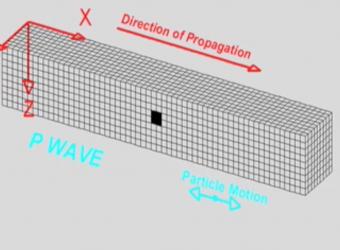
P waves are the first wave to hit the earths surface. P-waves also known as a compressional wave is the wave that shakes the ground in the same and opposite direction of the wave ie. These waves travel in the speed range of 15-13 kms.
Constructive interference D. CParticles of the wave medium move parallel to the direction of propagation of the wave. A wave is formed.
Which term best describes the movement of waves and how they interact with one anotherA. P waves refract at the boundary between the outer core and inner core. They travel through the Earths interior and can pass through both solid and molten rock.
The difference in arrival time of P and S waves. The direct P wave arrives first because its path is through the higher speed dense rocks deeper in the earth. In calculating the location of the epicenter of an earthquake which of the following factors is most useful.
The names primary and secondary refer to _____. These waves can travel through solid liquid and gas. Contractions and expansions that are in the direction of wave propagation D.
An S wave is a transverse wave and travels slower than a P wave thus arriving after the P wave. Body waves consist of the. S-waves lag behind P-waves as they travel 17.
Which statement best describes longitudinal waves. Snake-like motions parallel to the Earths surface C. A wave can be described as a disturbance that travels through a medium from one location to another location.
Wave behavior best describes the movement of waves and how they interact with one another. BLongitudinal waves do not require a material medium for propagation. Why do geologists believe the inner core is solid.
Seismic Wave Motions4 waves animated. Which of the following responses best describes the epicenter of an earthquake. The animations below illustrate both the propogation of the wave as well as the motion of particles as the wave.
With increasing travel time the difference in arrival times between the P and the S waves _____ increases decreases stays constant none of the above. P waves slow down and refract at the boundary between the mantle and the outer core. Shaking particles at right angles to the direction of travel.
Which of the three types of seismic waves travels through rock with the greatest velocity. Have the slowest velocity.
P Wave Motion Incorporated Research Institutions For Seismology

The Neuron Neurons Medical School Studying Nervous System
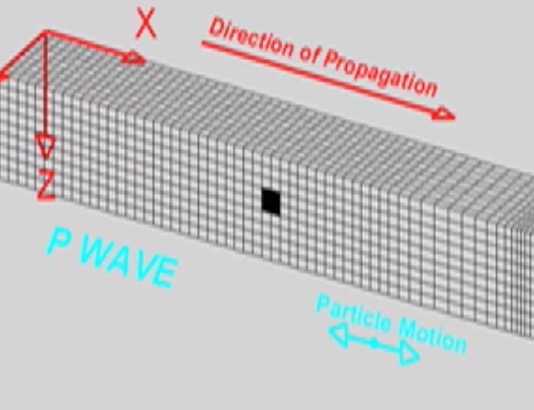
Seismic Wave Motions 4 Waves Animated Incorporated Research Institutions For Seismology
No comments for "What Best Describes the Movement of P Waves"
Post a Comment